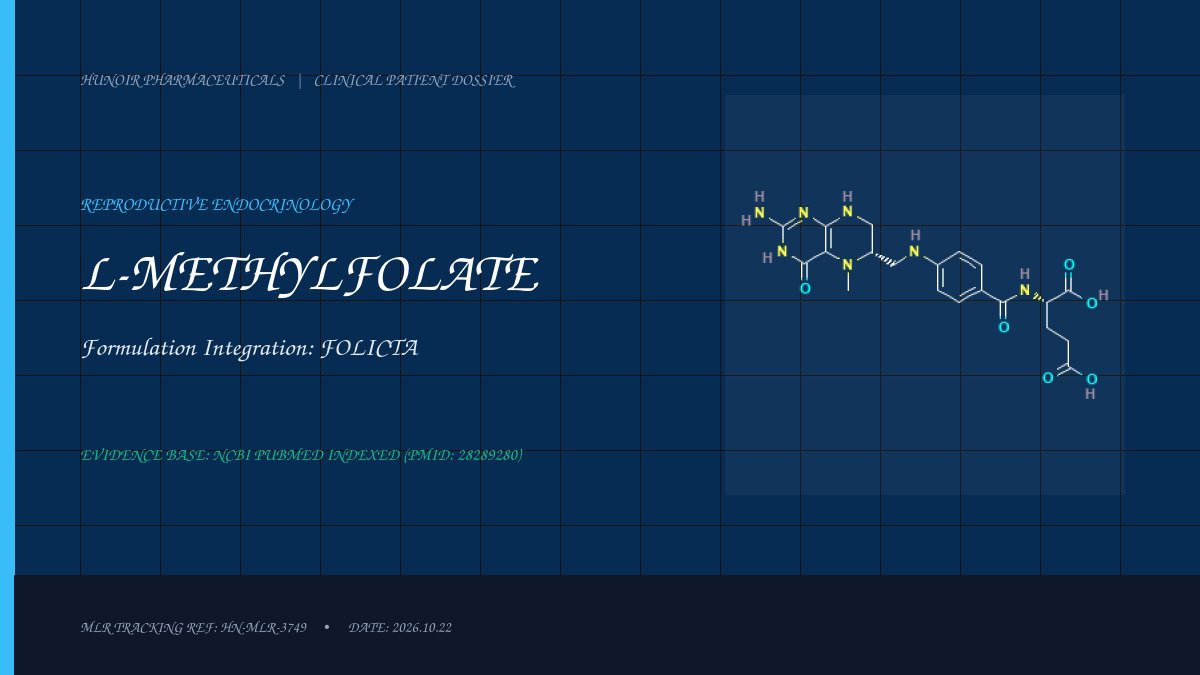
Executive Summary: For patients facing the complex challenges of impaired folate metabolism, particularly concerning neural tube defect prophylaxis and recurrent pregnancy loss, FOLICTA offers a highly bioavailable L-Methylfolate solution. This direct-acting formulation addresses fundamental physiological needs, mitigating the often exhausting metabolic burden and supporting critical health outcomes.
Mechanism of Action
FOLICTA delivers L-Methylfolate (5-MTHF), the primary, biologically active form of folate circulating in human plasma, directly into cellular pathways. This circumvents common enzymatic limitations, ensuring immediate physiological utilization and providing essential methyl donors for crucial biochemical reactions.
- Bypassing Enzymatic Bottlenecks: L-Methylfolate directly enters the cellular folate pool, efficiently providing active folate for individuals with MTHFR C677T or A1298C genetic variations who struggle to convert standard synthetic folic acid.
- Homocysteine Remethylation & DNA Synthesis: As a vital methyl donor, L-Methylfolate converts homocysteine back into methionine, safeguarding microvascular integrity and reducing cardiovascular and placental toxicity, while also facilitating purine and pyrimidine synthesis essential for cell division and neurodevelopment.
Clinical Evidence
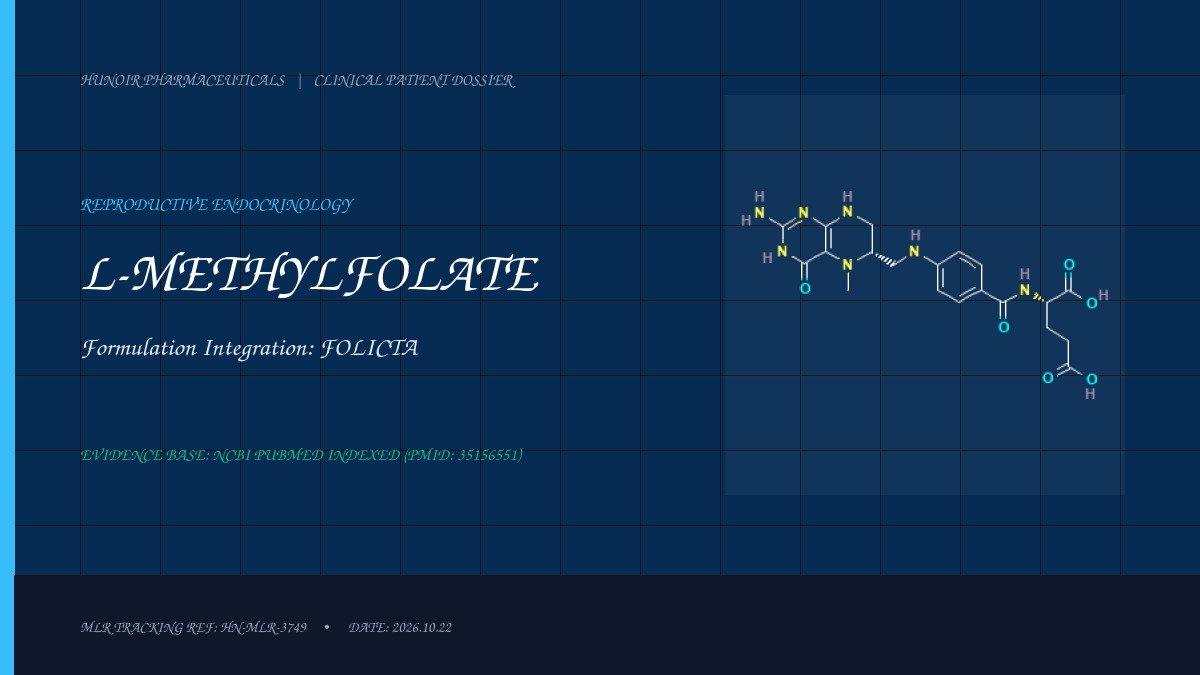
An investigative study examined the effects of a triple-combination therapy, including L-methylfolate, in women with polycystic ovary syndrome (PCOS). The study compared 100 PCOS women treated continuously for 6 months with Group A (myo-inositol, gymnemic acid, and L-methylfolate) or Group B (myo-inositol and folic acid only). While the primary disease state of PCOS is not an approved indication for FOLICTA, the study provided insights into L-methylfolate’s metabolic contributions relevant to folate homeostasis and homocysteine management. Results indicated that L-methylfolate contributed to maintaining stable folatemia and restoring normal homocysteine levels. Specifically, a more significant decrease in total cholesterol and homocysteine levels was observed in Group A compared to Group B. The study also highlighted L-methylfolate’s higher bioavailability, absence of drug/food interferences, high absorption, and stability to UV-A exposure, differentiating it from synthetic folic acid. These findings, particularly concerning the effective reduction of elevated homocysteine, reinforce FOLICTA’s utility in managing MTHFR gene polymorphisms and mitigating risks associated with hyperhomocysteinemia, such as those implicated in recurrent pregnancy loss and threats to placental vascular defense.
Safety & Integration
FOLICTA’s formulation provides L-Methylfolate, the biologically active folate, ensuring immediate physiological utilization without the need for complex enzymatic conversion. This direct approach offers a significant safety advantage over high-dose synthetic folic acid, as it prevents the systemic accumulation of Unmetabolized Folic Acid (UMFA), which may have uncharacterized long-term physiological implications. FOLICTA is absolutely contraindicated in individuals with known hypersensitivity to L-methylfolate or any excipients present in the formulation. Clinicians are advised that while efficacious for folate deficiency, folate therapy alone should not be employed to treat Addison’s pernicious anemia or other vitamin B12 deficiency states, as it may mask the neurological progression of these conditions unless adequate B12 is co-administered.
Clinical FAQs
Q: How does FOLICTA specifically benefit patients with MTHFR gene polymorphisms?
A: FOLICTA contains L-Methylfolate, which is the metabolically active form of folate. This allows it to directly enter the body’s folate metabolic pathways, entirely bypassing the MTHFR enzyme, thereby ensuring efficient folate utilization and homocysteine remethylation for individuals with MTHFR C677T or A1298C mutations who cannot efficiently process standard synthetic folic acid.
Q: What is the primary safety advantage of L-Methylfolate in FOLICTA compared to high-dose synthetic folic acid?
A: The core safety advantage of L-Methylfolate in FOLICTA is that it does not result in the accumulation of Unmetabolized Folic Acid (UMFA) in the systemic circulation. This provides a superior and safer physiological profile by circumventing potential metabolic burdens associated with UMFA observed with high-dose synthetic folic acid.